Foundations
In short: Dewatering is pumping groundwater out of the ground so a footing, basement, pool or service trench can be dug below the water table. In WA, DWER exempts construction dewatering in the water table aquifer from a water licence only if pumping is at most 10 litres per second, lasts under 30 consecutive days and totals no more than 25,000 kilolitres.
Key takeaways
- DWER's licence exemption for construction dewatering applies only at 10 L/s or less, under 30 consecutive days and 25,000 kL or less.
- Discharge may need its own approval: local government for local stormwater drains, Water Corporation for sewer and main drains.
- WQPN 13 lists recharge to local groundwater first among disposal options, ahead of reuse, irrigation and discharge to waterways.
- DWER says an acid sulfate soil investigation and management plan may be required for any dewatering or drainage works.
- WQPN 13 calls for the drawdown cone to be estimated, including any threat to existing structures from land movement.
Digging footings, a basement or a pool below the water table in Perth or Mandurah? Send us your plans and site details for a footing design quote, or call 1300 614 803.
What is dewatering, and when is it needed?
Dewatering is the temporary pumping of groundwater out of the soil so that an excavation can be dug and built in the dry. It is generally needed when the excavation for a footing, basement, pool or service trench reaches groundwater. The Department of Water's Water quality protection note 13 (WQPN 13), Dewatering of soils at construction sites, covers short-term dewatering that removes groundwater seepage, water in excavations that intersect aquifers, and water in pits flooded by storms. Its main purpose is to guide the environmental management of dewatering at construction sites and during the installation of buried structures and services (WQPN 13). The Department of Water is now part of the Department of Water and Environmental Regulation (DWER), and the note dates from November 2012.
To plan a dewatering job, WQPN 13 asks for the site's seasonal standing groundwater levels, soil types and hydrogeology, and points to the Perth Groundwater Atlas for indicative water table information in the Perth region.
How is a Perth building site dewatered?
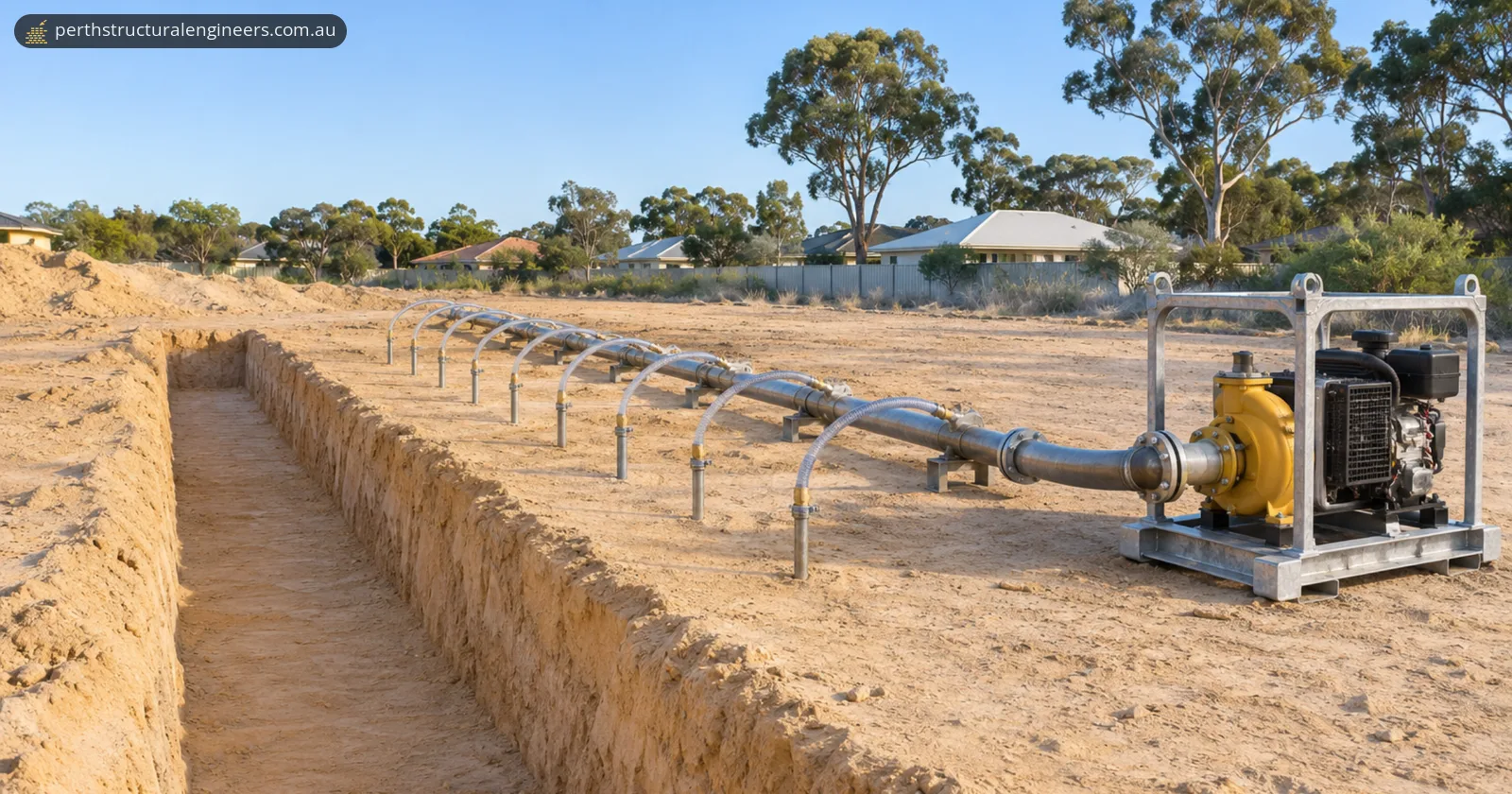
A Perth building site can be dewatered in several ways, and WQPN 13 names three example techniques:
- spears connected to a pump manifold;
- a bore-field;
- a pit and sludge pump.
WQPN 13 also lists measures that may limit how far the dewatering reaches beyond the site: starting dewatering at the end of the dry season, sheet-piling, hydraulic barriers, grout curtains or ground-freezing.
DWER's acid sulfate soil guidance adds physical barriers such as caissons or diaphragm walls, to limit the lateral and vertical extent of drawdown (DWER fact sheet 4).
Do you need a licence for dewatering in WA?
A water licence is not needed for construction dewatering in WA if every condition of DWER's exemption is met; otherwise a licence may be needed. DWER's water licensing exemptions page says no licence is required for dewatering if:
| Condition | Exemption limit |
|---|---|
| Aquifer | The development is within the water table (non-artesian) aquifer |
| Purpose | Water is taken solely to remove underground water to facilitate construction |
| Pump rate | Not more than 10 litres per second |
| Duration | Less than 30 consecutive days |
| Total volume | Not more than 25,000 kilolitres over the period |
The exemption does not cover the extraction of basic raw materials, or work that would lower the natural ground level. Where the exemption does not apply, a licence is needed to take groundwater from proclaimed areas under the Rights in Water and Irrigation Act 1914 (WQPN 13, Appendices B and D).
Where can dewatering water go in Perth?
Dewatering water in Perth can go back into the ground, be reused, or be discharged to drains or waterways, and each route has its own conditions. WQPN 13 lists the disposal options in this preferred order:
| Order | Disposal option | Main condition in WQPN 13 |
|---|---|---|
| 1 | Recharge of local groundwater | Water quality meets the criteria; enough area and aquifer capacity, without risk to native vegetation, wetlands, structures or services |
| 2 | Recycling (dust control, wash-down and similar) | Quality suits the use; acceptable to the Department of Health and the local government |
| 3 | Irrigation of vegetated land | Meets the Australian and New Zealand (ANZECC 2000) irrigation criteria and the plants' seasonal needs |
| 4 | Water use off-site by pumping or carting | A written agreement with the owner of the receiving site |
| 5 | Discharge into nearby waterways | Quality criteria met; written approval from the owner of any drains used, such as the Water Corporation for main drains and local government for local drains |
| 6 | Storage in a pond | For reuse or disposal by controlled seepage |
| 7 | Solar evaporation | In a lined containment basin |
Where the water may carry significant suspended solids, WQPN 13 says a settling basin or balance tank holding at least two hours of dewatering flow should be used before discharge.
What approvals apply to dewatering in Perth?
Dewatering in Perth can involve several approvals at once: a water licence unless the exemption applies, approval to discharge, and in some areas a management plan. The Department of Biodiversity, Conservation and Attractions (DBCA) guidance note for dewatering within or affecting the Swan Canning development control area lists the first four approvals below; it also gives a recommended structure for the plan in the last row:
| Approval | Who | When |
|---|---|---|
| Water licence | DWER | May be required (exemptions apply) |
| Discharge to local stormwater | Local government | May be required when discharging to the local stormwater system |
| Discharge to sewer | Water Corporation | May be required when discharging to the sewerage system |
| Reuse of tailwater on site | Department of Health | May require approval |
| Dewatering Management Plan | Prepared by the proponent (DBCA's guidance note gives its structure); tailwater quality data go to DBCA and the local government for assessment before any discharge | For dewatering within or affecting the Swan Canning development control area |
For that area, the guidance note says post-treatment tailwater test results go to DBCA at least 14 days before dewatering is due to start. It says the plan's objectives should align with DBCA's Corporate Policy Statement 50 and WQPN 13.
Does dewatering affect acid sulfate soils in Perth?
Dewatering can disturb acid sulfate soils (ASS), and DWER says an ASS site investigation and management plan may be required for any development that includes dewatering or drainage works. DWER notes that ASS are common along WA's coastal plains in waterlogged, groundwater-dependent and high watertable environments (DWER fact sheet 3). Its risk maps, available through Landgate's WA Atlas, give a first indication that ASS could be present on a site.
WQPN 13 explains the risk: lowering the water table can expose iron sulfide (pyrite) in the soil to air, producing acidic conditions that can release toxic metals into groundwater. DWER's fact sheet 4 adds that soil acidification could cause infrastructure damage, and that dewatering should not start until the dewatering management plan has been prepared.
Can dewatering damage neighbouring footings?
Dewatering can affect the ground beyond the site, so WQPN 13 recommends assessing the risk to nearby structures before pumping starts. It asks for the profile and radius of influence of the drawdown cone to be estimated, including any threat to vegetation or existing structures from land movement. It says this should be modelled under an experienced hydrogeologist's supervision, although empirical methods may be used for small, short projects.
During the work, WQPN 13 recommends monthly readings of water levels in surrounding piezometers to assess drawdown effects and any impacts on structures. It says dewatering should not cause changes to the water table, water quality or hydrology that may cause significant adverse effects on neighbouring properties. Any incidental harm to people, property or water bodies should be remedied immediately by the dewatering system operator.
The neighbour's land is also protected under WA's Building Act 2011. The WA Government's guide for registered builders says adversely affecting land includes reducing the stability or bearing capacity of the land, or of a building or structure on it, and that work must not adversely affect land beyond the work land without the owner's consent, given on Form BA20, or a Magistrates Court order.
When to call a structural engineer
Call a structural engineer when the excavation for your project may reach the water table, or when dewatering could affect your footings or a neighbour's. Call one if:
- a basement, pool or deep footing is planned on a block with shallow groundwater;
- the dewatering will run outside DWER's exemption limits, so the drawdown and its effect on structures need to be assessed;
- a neighbouring house sits close to the excavation and you want its condition recorded before work starts;
- the site is in a mapped acid sulfate soil risk area and the footing design must allow for it.
Our structural engineering services include footing and foundation design, new basement design, swimming pools and dilapidation reports. For footings on sand, see our guides to strip footings on Perth sand and compaction testing. We work across the Perth metro area and Mandurah; our service areas page lists the suburbs we cover.
Frequently asked questions
How can I check the depth to groundwater under my block?
Use the Department of Water and Environmental Regulation's Perth Groundwater Map. It estimates the depth to the water table and to the base of the superficial (water table) aquifer beneath a property.
What if the pumped water is acidic?
WQPN 13 says that where extracted water has a pH below 6 and titrated acidity above 40 milligrams per litre, it may be necessary to dose it with an alkali such as lime to raise the pH to at least 6.5, and to aerate it.
Who should neighbours contact while dewatering is running?
WQPN 13 recommends that the business or agency doing the dewatering consult local residents and businesses likely to be affected, and have a contact person available during the operation to manage any issues.
What is a dewatering management plan?
It is a document setting out the dewatering method, volumes, schedule, disposal options, monitoring and a contingency plan. DBCA's guidance note gives a recommended structure for plans within or affecting the Swan Canning development control area.
Sources
- DWER: Water licensing exemptions
- Department of Water (now DWER): Water quality protection note 13, Dewatering of soils at construction sites (November 2012)
- DBCA: Dewatering Management Plan guidance note (July 2026, V1)
- DWER: Acid sulfate soils fact sheet 4, Managing urban development in acid sulfate soil areas (October 2024)
- DWER: Acid sulfate soils fact sheet 3, Acid sulfate soil risk maps (October 2024)
- DWER: Perth groundwater map
- WA Government: Information and obligations for registered builders (work affecting other land)