Foundations
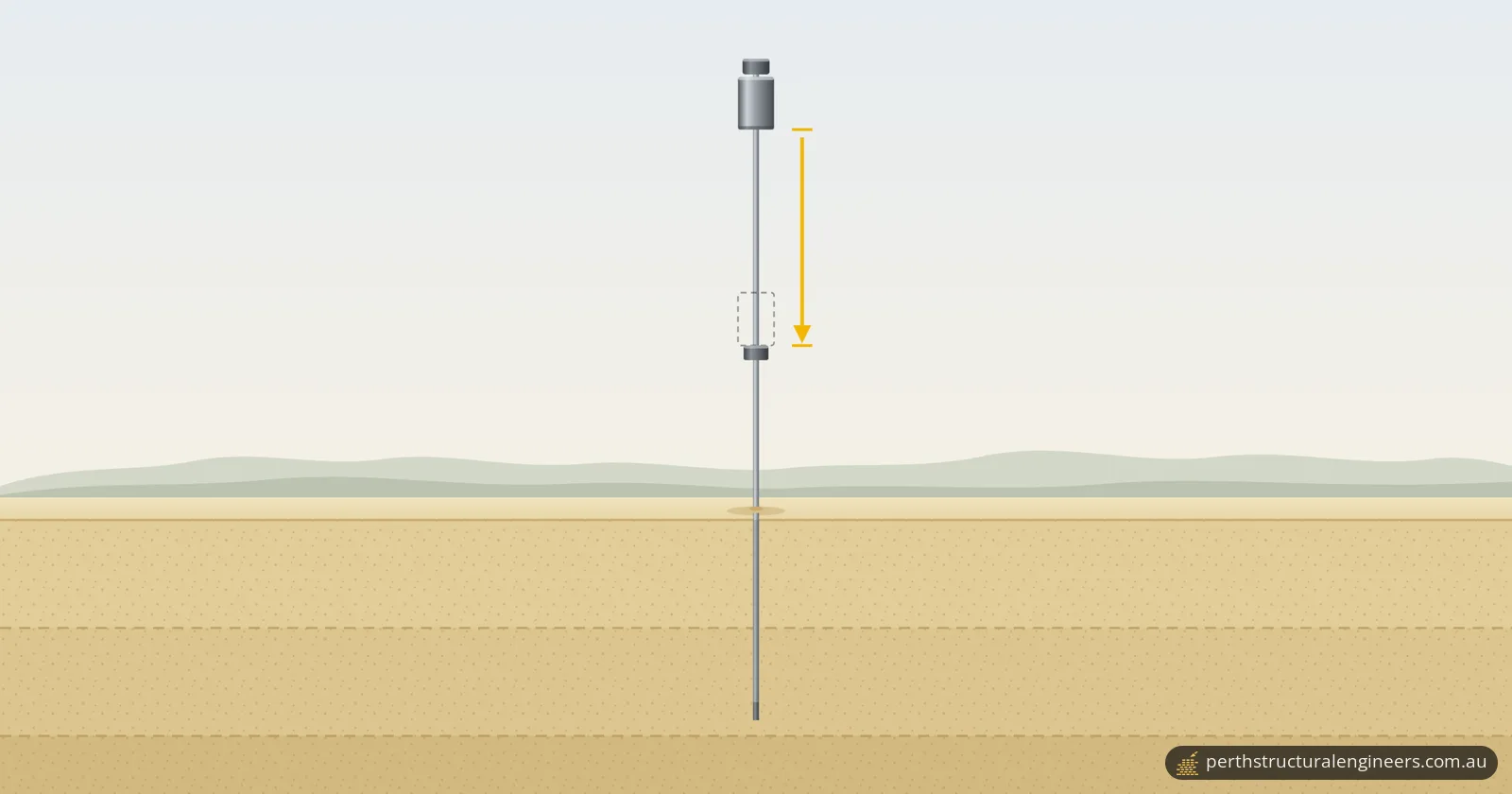
In short: A compaction test on Perth sand checks that the sand under a footing or slab is dense enough to carry the house with minimum movement. The National Construction Code (NCC) Housing Provisions specify the Perth sand penetrometer (PSP) test in AS 1289.6.3.3: a 9 kg weight dropping 600 mm drives a 16 mm flat-ended rod. Sand fill under a slab must reach 7 or more blows per 300 mm.
Key takeaways
- Under the NCC Housing Provisions, sand fill under a slab must reach 7 or more blows per 300 mm, tested to AS 1289.6.3.3.
- Controlled sand fill can be up to 800 mm deep, compacted in layers of no more than 300 mm by vibrating plate or vibrating roller.
- AS 1289.6.3.3 limits the PSP to granular soils with particles up to 2 mm, in a layer at least 450 mm thick.
- In WA, the builder named on the building permit must make sure inspections referenced on the certificate of design compliance are done and certificates obtained.
- A 2012 calibration study found blow counts rise with depth at the same density; its authors say density read from PSP results needs engineering judgement.
Building on sand in Perth or Mandurah? Send us your site classification and plans for a footing design quote, or call 1300 614 803.
What is a compaction test on Perth sand?
A compaction test on Perth sand checks how dense the sand under a footing or slab is, so you know it can carry the house with minimum movement. The Australian Building Codes Board's National Construction Code (NCC) Housing Provisions set that aim for foundations: the strength or bearing capacity to carry the building load with minimum movement. Where building work disturbs the soil, as on cut and filled sites, they say its bearing capacity can be dramatically altered, and the soil needs to be consolidated, generally via compaction (NCC 2022 Housing Provisions, Part 4.2).
In the Perth area, sand compaction has long been checked with a penetrometer. A 1979 paper to the Institution of Engineers, Australia on compaction control in Perth sands reported a survey showing extensive use of the 9 kg, 600 mm drop, 16 mm rod penetrometer as an alternative to field density testing (Clegg, 1979).
How is the Perth sand penetrometer (PSP) test done?
The Perth sand penetrometer (PSP) test drives a 16 mm flat-ended steel rod into the sand with a 9 kg weight dropped 600 mm, and counts the blows. The method is Australian Standard AS 1289.6.3.3, which Standards Australia lists as current, published in 1997, with one amendment and a 2013 reconfirmation (Standards Australia; summary also on New Zealand's Building CodeHub).
- The equipment. The standard's summary describes a flat-ended rod 16 ± 0.2 mm in diameter, driven with a 9 kg mass dropping 600 mm. A 2012 calibration study by Mohammadi, Fityus and Bates (PDF) adds that the weight falls onto an anvil block, and that the device weighs under 20 kg and is worked by hand.
- The soil it suits. The standard limits the method to granular soils with a maximum particle size not exceeding 2 mm, and a layer thickness of at least 450 mm.
- Reading the result. In the study's chamber tests, the number of blows generally increased with the sand's density and with confining pressure.
How many blows does a compaction test need?
For sand fill under a house slab, the NCC Housing Provisions set a blow count of 7 or more per 300 mm, using the test method in AS 1289.6.3.3. Clause 4.2.4 also says sand used in the fill must not contain any gravel-size material. The wording is the same in the NCC 2022 and NCC 2025 Housing Provisions.
The clause allows two kinds of fill under a slab, each with its own depth and layer limits:
| Fill type | Material | Maximum depth | Layers | Compacted by |
|---|---|---|---|---|
| Controlled fill | Sand | 800 mm | Not more than 300 mm | Vibrating plate or vibrating roller |
| Controlled fill | Clay | 400 mm | Not more than 150 mm | Mechanical roller |
| Rolled fill | Sand | 600 mm | Not more than 300 mm | Repeated rolling by an excavator or other suitable mechanical equipment |
| Rolled fill | Clay | 300 mm | Not more than 150 mm | Repeated rolling by an excavator or similar machine |
Clay used in either kind of fill must be moist during compaction. A level layer of clean quarry sand, at least 20 mm deep, then goes on top of the fill. The NCC's explanatory note says fill beyond these depths will need to be installed in accordance with clause H1D4(1) instead.
Blow counts also depend on depth, not just density. In the 2012 calibration study's laboratory chamber tests at the University of Newcastle (NSW), on dune sand from Stockton Beach, sand at the same 80% relative density took from 3 blows per 150 mm at 200 mm depth to 8 blows per 150 mm at 750 mm. The authors conclude that inferring in situ density with the PSP and their calibration chart must, in all cases, be tempered by engineering judgement and experience.
Who does the compaction test and signs it off in WA?
In Western Australia, a technician or a laboratory accredited by the National Association of Testing Authorities (NATA) can run the PSP to AS 1289.6.3.3, the Shire of Harvey (for one) advises getting the compaction certificate from a suitably qualified professional engineer, and the builder named on the building permit must make sure inspections referenced on the certificate of design compliance (CDC) are done.
| Who | Their part |
|---|---|
| Registered building surveyor | Issues the CDC once satisfied the plans comply with the applicable building standards, generally the NCC; may require inspections during construction |
| Builder named on the building permit | Builds to the approved plans and specifications, and makes sure inspections referenced on the CDC are carried out and the certificates obtained |
| Professional engineer | Can certify that soil compaction below the footings and ground slab is satisfactory to support the building; the Shire of Harvey advises getting this certificate from a suitably qualified one |
| Testing laboratory | NATA accredits laboratories for the Perth sand penetrometer test under AS 1289.6.3.3 |
| Permit authority | Receives the Notice of Completion (form BA7), with certificates for inspections or testing referenced on the CDC attached |
The surveyor, builder and permit authority roles are from the City of Bayswater's guide to building approvals under the Building Act 2011. The engineer's role is from the Shire of Harvey's advice notes, which add that a copy of the certificate may be submitted to the Shire for record keeping.
To check a laboratory, look up its scope on NATA's website. For example, NATA lists Main Roads WA's Great Southern Materials Laboratory for the Perth sand penetrometer test under AS 1289.6.3.3.
How do Perth's sands change the compaction rules?
The NCC Housing Provisions name the sands around Perth in one note, and their sand rules cut both ways: extremely stable sands can allow a thinner slab, while loose sands and dune sands need more care.
- Site classes. Table 4.2.2 describes Class A sites as most sand and rock sites, with little or no ground movement from moisture changes. Class P covers sites with soft soils, such as loose sands.
- Stable sands. For Class A footing slabs (Figure 4.2.16), in parts of Western Australia around Perth (and other locations) where the site consists of extremely stable sands, and where a professional engineer specifies it, the slab thickness may be reduced to 85 mm. The same figure notes that dune sands may require compaction.
- Loose sand. On loose sand sites, or sites subject to wind or water erosion, the bottom of the footings must be at least 300 mm below finished ground level (clause 4.2.3).
- Footings on fill. Pad footings, strip footings and edge beams not connected to the slab must sit on natural soil with an allowable bearing pressure of at least 100 kPa. On Class A and S sites, they may instead be founded on controlled sand fill to clause 4.2.4(a). Our guide to strip footings on Perth sand covers how this applies to strip footings.
What happens if a site fails a compaction test?
Sand fill that falls short of 7 blows per 300 mm does not comply with clause 4.2.4 of the NCC Housing Provisions, so the footings and slab cannot rely on it under those details until the fill is fixed or the design changes. The Housing Provisions don't set out a procedure for a failed test. Their fill and footing clauses point to these options:
- Fill that meets clause 4.2.4: sand fill placed and compacted in layers within the clause 4.2.4 limits, reaching 7 or more blows per 300 mm.
- Edge beams taken through the fill: Options 2 and 3 of Figure 4.2.5 show edge beams extending through the fill into undisturbed soil with the required bearing capacity. Slab panels and internal beams on fill still need fill compacted to clause 4.2.4 (clause 4.2.5(a)).
- A design to AS 2870: sites with loose sands can be classified P, and for Class P sites the Housing Provisions say reference must be made to AS 2870 for design and construction information.
When to call a structural engineer
Call a structural engineer when the sand under your house falls outside the Housing Provisions' standard fill details, or a test result puts the footing design in doubt. Call one if:
- the fill will be deeper than 800 mm of controlled sand fill or 600 mm of rolled sand fill;
- a PSP test falls short of 7 blows per 300 mm and the footings may need to change;
- the site classification report gives Class P, for example because of loose sands;
- you want the reduced 85 mm slab on extremely stable sand, which the Housing Provisions allow only where a professional engineer specifies it.
Our structural engineering services include footing and foundation design, concrete slab design, and site inspection and assessment. We work across the Perth metro area and in Mandurah; our service areas page lists the suburbs we cover.
Frequently asked questions
Is the PSP the same as a dynamic cone (Scala) penetrometer test?
No. The dynamic cone (Scala) penetrometer, whose test method is AS 1289.6.3.2, also uses a 9 kg weight, but with a 510 mm drop and a conical point up to 20 mm wide. Australian practice uses it for pavement subgrades and mixed soils.
How is compaction checked on clay fill?
With other methods. The City of Kwinana's specification for trafficable areas in industrial areas says the Perth sand penetrometer is to be strictly used for sandy soils, and that for clayey soil other methods, such as a nuclear density meter, may be used.
Does wet or dry sand change the result?
It can. A 1979 review of penetrometer use in Perth sands discussed how sand type, depth and moisture content influence penetration resistance. Main Roads WA's earthworks specification, written for road works, has material lightly watered or dried during compaction to maintain an appropriate moisture content to achieve the required density.
How deep can a PSP test go?
Several metres. Extra rods can be added once the rod is driven, and the 2012 calibration study says a single residential block can be characterised to 2 or 3 m by one technician in 1 or 2 hours. Its authors put the practical limit at about 5 or 6 m in exceptionally loose conditions.
Can compaction equipment affect neighbouring homes?
It may. The Shire of Harvey's building advice notes say compaction equipment must be of a suitable type so as to minimise any damage or disturbance to properties within the vicinity of the building works.
Sources
- ABCB: NCC 2022 Housing Provisions, Part 4.2 Footings, slabs and associated elements
- ABCB: NCC 2025 Housing Provisions, Part 4.2 Footings, slabs and associated elements
- Standards Australia: AS 1289.6.3.3-1997 Perth sand penetrometer test
- Building CodeHub (New Zealand Government): AS 1289.6.3.3-1997 (R2013) summary
- Mohammadi, Fityus and Bates (2012): Calibration of the Perth sand penetrometer (PSP) for silica sands
- Clegg (1979): Penetrometer application, sands, Perth (TRID record)
- NATA: Great Southern Materials Laboratory (Main Roads WA), accreditation scope
- City of Bayswater: A guide to the building approvals process
- Shire of Harvey: Building in the Shire of Harvey, advice notes
- Main Roads WA: Specification 302 Earthworks
- City of Kwinana: Specifications for pavement and drainage of trafficable areas in industrial areas